

Why Material Selections Change a Kitchen Budget
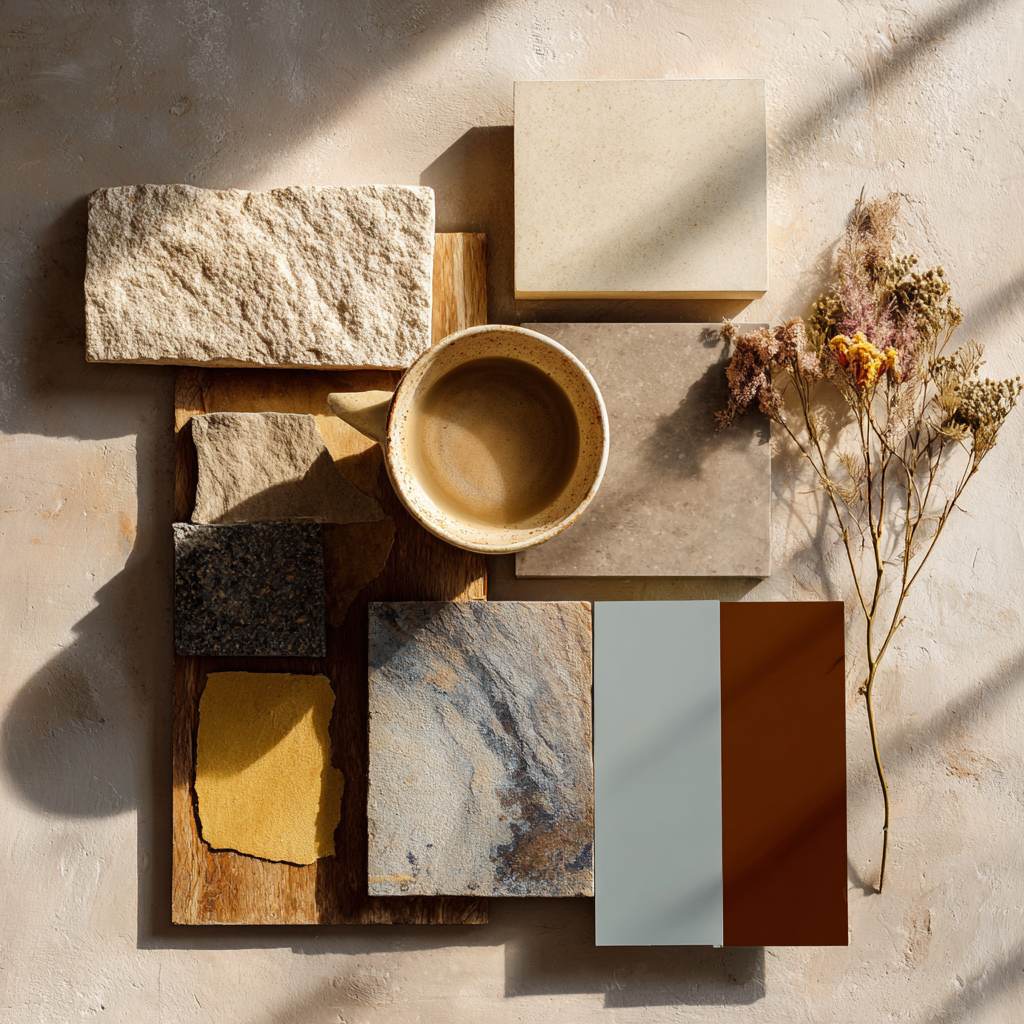
Image: Greek countryside inspired material board.
Two kitchens can share the same dimensions and look broadly similar in a rendering and they have completely different prices, lifespans and maintenance requirements.
The difference is hidden inside the cabinetry, beneath the counter or worktop and, behind the finish. This is why comparing quotations by price alone is unrealistic. You need to know exactly what is being supplied.
Below we’ll break down the materials offered in Greece and explain the pros and cons of each so that you can decide where you really want place your kitchen renovation budget.
Cabinet Materials
Melamine-Faced Particle Board
Particleboard is made from compressed wood particles and resin with a decorative melamine, think hard plastic or laminate, surface applied over it.
Advantages
Economical and widely available
Consistent colour and finish
Efficient for standard cabinet boxes and rental projects
Easy to replace when using modular dimensions
Disadvantages
Quality varies enormously
Low-density versions have weaker screw-holding capacity
Cut edges and poorly sealed joints are vulnerable to moisture
Swelling is generally irreversible
Less suitable for highly bespoke forms or cabinetry expected to last decades
High-quality, moisture-resistant particleboard can be appropriate for selected commercial interiors or internal cabinet components. Cheap particleboard with poor edging is not equivalent.
SDLS notes: If you plan to replace it later, it is good enough for a few years and a tight budget. Ideally, keep going down the list.
MDF
Medium-density fibreboard is smoother and denser than particleboard, making it suitable for painted, lacquered, routed and detailed cabinet fronts.
Advantages
Smooth surface for painted and lacquered finishes
Can be routed for Shaker, fluted or decorative profiles
Stable and consistent
More economical than solid timber
Useful for bespoke cabinet-door designs
Disadvantages
Heavy
Standard MDF can swell when exposed to water
Damaged corners can be difficult to repair invisibly
Performance depends on board grade, sealing and fabrication quality
For kitchens, moisture-resistant MDF and properly sealed edges matter. “MDF” alone is not a complete specification.
SDLS notes: Our review is that MDF is perfectly fine, not perfect, but quite good from an aesthetic, economical and functional point of view. From a range of colors to decorative cabinet faces, MDFs versatility is one that can give you unique design at an affordable price.
Plywood
Plywood is formed from multiple timber veneers laminated in alternating directions.
Advantages
Strong and structurally stable
Better screw-holding ability than many lower-density boards
More resistant to occasional moisture when the correct grade is specified
Attractive exposed edges can become part of a contemporary design
Well suited to bespoke cabinetry
Disadvantages
More expensive
Visible edges require intentional detailing
Surface quality varies by grade
Poorly fabricated plywood can delaminate
Not every plywood product is moisture-resistant or appropriate for kitchens
Plywood is not automatically premium. Its grade, core, face veneer, adhesive and finishing determine its performance.
SDLS notes: If you want to do your kitchen cabinets once and maybe just refresh the outer cabinets if you get bored, plywood is a worthy investment. You can always change the paint color, and stain decades down the road. From an investment standpoint, buyers understand that wood is always a better option and can be easily changed to match their personal taste.
Natural Wood Veneer
A thin layer of real timber is bonded to a stable substrate such as furniture-grade MDF or plywood.
Advantages
Provides the depth, grain and warmth of natural wood
More dimensionally stable than using solid timber for every component
Allows grain matching across doors and panels
Can create a highly refined, bespoke finish
Uses valuable timber more efficiently
Disadvantages
Requires skilled selection and fabrication
Colour and grain naturally vary
Can fade or change tone with sunlight
Damaged veneer can be difficult to repair
Premium veneers and book-matching increase the cost
Veneer is not “fake wood.” In quality joinery, it is often the more stable and technically appropriate way to create a natural timber kitchen.
SDLS notes: Veneer can be lovely when properly applied and when the proper thickness is used. With a little TLC and you can enjoy it for a long time. Ask your designer where the best placement and use of veneer can be if you are considering a “wood look” for your kitchen.
Solid Wood
Solid timber may be used for doors, frames, decorative details, work tables or selected cabinetry.
Advantages
Natural character and tactile quality
Can often be repaired, sanded or refinished
Develops patina over time
Appropriate for heritage, traditional and highly crafted kitchens
Disadvantages
Expands and contracts with changes in temperature and humidity
More expensive
Requires skilled joinery
Can warp when poorly seasoned or incorrectly fabricated
Not always the best material for large flat doors or complex moving components
SDLS notes: Solid wood should be used because it improves the design—not because “solid” sounds more luxurious. You also want to consider if the investment you are making in solid wood is because you are creating a forever dream kitchen, or a even a heritage property that will be passed down through your family.
High-Pressure Laminate and Advanced Laminates
High-pressure laminate is applied to an appropriate substrate. Premium versions include highly tactile, anti-fingerprint, matte and compact surfaces.
Advantages
Durable and easy to maintain
Wide selection of colours, textures and patterns
Good resistance to normal wear and staining
Appropriate for high-use commercial and rental kitchens
Can deliver a crisp contemporary appearance
Disadvantages
Exposed or poorly sealed edges can fail
Repairing deep chips is difficult
Quality varies considerably
Cheap printed finishes can look artificial
The final result depends heavily on the substrate and edge detailing
SDLS notes: A premium laminate system with excellent fabrication is very different from thin, poorly bonded foil over a low-grade cabinet door. We do not recommend this in rental properties.
Lacquered Cabinetry
Lacquer is sprayed over a prepared MDF or timber substrate in matte, satin or gloss finishes.
Advantages
Broad colour freedom
Refined, seamless appearance
Can be applied to routed or shaped doors
Allows the kitchen palette to be developed specifically for the property
Disadvantages
More expensive than standard factory laminates
Dark gloss finishes show fingerprints and imperfections
Chipped corners require professional repair
Quality depends on surface preparation and the spraying process
Longer production time
SDLS notes: The investment pays for preparation, repeated coating, curing, finishing and quality control.
Backsplash Materials
Ceramic Tile
Advantages
Broad range of colours, patterns and handmade finishes
Appropriate for historic, Mediterranean and character-led interiors
Individual tiles can sometimes be replaced
Available across many price levels
Disadvantages
Grout requires maintenance
Handmade tiles vary in size and surface
Complex patterns increase installation labour
Poor-quality tile can chip or craze unexpectedly
Porcelain Tile
Advantages
Dense, durable and low-absorption
Easy to maintain
Available in stone, concrete and metal effects
Suitable for demanding residential and commercial kitchens
Disadvantages
Harder to cut and drill
Large formats require skilled installation
Printed stone effects can look repetitive at lower quality levels
Edge finishing needs careful consideration
Natural Stone
Marble, granite, limestone and quartzite can continue from the countertop onto the wall.
Advantages
Natural variation makes every installation unique
Creates visual continuity
Can become the defining architectural material
Excellent depth and authenticity
Disadvantages
Some stones are porous and require sealing
Marble and limestone can etch from acids
Slab selection and pattern placement require design oversight
Weight, transport and specialist installation increase costs
Natural fissures and variation are part of the material
Natural stone should be selected slab by slab. A small sample does not show the whole story.
Engineered Quartz
Advantages
Consistent colour and pattern
Non-porous and easy to maintain
Can continue from worktop to backsplash
Available in large formats with fewer joints
Disadvantages
Less heat-resistant than sintered or natural stone surfaces
Repeated patterns can appear manufactured
Resin content makes outdoor or high-UV use inappropriate for many products
Premium brands and specialist fabrication increase the cost
Large-Format Porcelain and Sintered Surfaces
Advantages
Highly resistant to stains, heat and abrasion
Very low water absorption
Large slabs reduce grout lines
Suitable for contemporary and high-use kitchens
Some products can continue across worktops, walls and cabinet fronts
Disadvantages
Requires specialist templating and fabrication
Edges can chip during handling or installation
Thin material needs correct support
Vein matching and edge construction require careful design
Premium products carry higher fabrication costs
Glass
Advantages
Smooth and easy to clean
Available in custom colours
Reflects light in smaller kitchens
Minimal joints
Disadvantages
Shows grease and water marks
Requires accurate templating
Cut-outs must be planned before toughening
Scratches or damaged colour backing can be difficult to repair
Stainless Steel
Advantages
Hygienic and non-porous
Heat- and water-resistant
Ideal for professional, industrial or highly contemporary kitchens
Can integrate with worktops and sinks
Disadvantages
Shows fingerprints and scratches
Requires expert fabrication
Can feel clinical if not balanced with warmer materials
Large flawless sheets are expensive
Microcement and Specialist Plaster
Advantages
Creates a continuous, tactile surface
Useful for Mediterranean and architectural interiors
Available in custom tones
Minimal visual joints
Disadvantages
Performance depends heavily on the applicator and sealing system
Can crack if the substrate moves
Requires maintenance and careful cleaning
Not every decorative plaster is suitable behind a cooktop or sink
Countertop Materials
High-Pressure Laminate
Advantages
Cost-controlled
Large variety of colours and effects
Quick to fabricate and install
Easy everyday maintenance
Disadvantages
Vulnerable at seams and cut-outs if water penetrates
Limited heat resistance
Difficult to repair after burns or deep chips
Printed stone patterns lack the depth of real or engineered slabs
SDLS notes: A high-quality laminate can be appropriate for a commercial brief. As a studio, our preference is that we do not specify low-grade laminate as though it were equivalent to stone.
Solid Surface
Solid-surface materials combine minerals and resins and can be joined with minimal visible seams.
Advantages
Non-porous
Can form integrated sinks and curved details
Repairable and renewable
Useful for seamless, sculptural designs
Disadvantages
Softer than quartz, porcelain and many natural stones
Can scratch
Vulnerable to high heat
Requires approved fabrication
Engineered Quartz
Advantages
Non-porous and low-maintenance
Consistent appearance
Good resistance to staining and normal scratching
Broad design selection
Disadvantages
Hot cookware should not be placed directly on it
Less suitable for outdoor kitchens
Veining can look repetitive
Difficult to repair invisibly after significant damage
Granite
Advantages
Durable and heat-resistant
Natural variation
Good resistance to normal kitchen wear
Appropriate for long-term residential use
Disadvantages
Some varieties require sealing
Heavy
Colour and pattern must be selected from the full slab
Repairs and seams may remain visible
Marble
Advantages
Exceptional natural depth and movement
Develops a distinctive patina
Appropriate for art-forward and heritage interiors
Each slab is unique
Disadvantages
Etches when exposed to acids
Can stain if not properly sealed and maintained
Scratches more easily than granite or sintered surfaces
Requires a client who accepts natural ageing
Marble is not a maintenance-free surface. That is not a defect; it is part of the material decision.
Quartzite
Advantages
Natural stone with dramatic movement
Often harder than marble
Strong visual impact
Appropriate for premium kitchens
Disadvantages
Performance varies by stone
Some materials sold as quartzite are softer mixed stones
Requires sealing
Premium slabs, transport and fabrication are expensive
Large-Format Porcelain or Sintered Stone
Advantages
High resistance to heat, staining, UV and abrasion
Very low porosity
Suitable for residential, commercial and outdoor kitchens
Can create thin, precise contemporary details
Disadvantages
Specialist fabrication is essential
Edges can be vulnerable to impact
Complex sinks and edge profiles increase cost
Poor installation can undermine a very expensive material
Stainless Steel
Advantages
Hygienic, heat-resistant and non-porous
Can integrate worktop, backsplash and sink
Ideal for serious cooking and commercial use
Develops an honest working patina
Disadvantages
Scratches
Shows fingerprints and water marks
Specialist fabrication is expensive
The industrial appearance is not appropriate for every home
Custom Concrete
Advantages
Can be cast to bespoke dimensions
Allows integrated sinks, drainers and sculptural forms
Distinctive and property-specific
Suitable for contemporary rustic and architectural concepts
Disadvantages
Heavy
May develop hairline cracks and patina
Requires correct reinforcement, curing and sealing
Can stain if the protective system fails
Quality depends entirely on the fabricator
Faucets and Taps
The material inside a faucet matters more than the colour outside it. In Greek villages where we have harsh water, the material outside matters, too.
Quality Brass
Advantages
Durable and widely serviceable
Suitable for complex valves and pull-out mechanisms
Broad selection of designs and finishes
Replacement cartridges and parts are often available from established manufacturers
Disadvantages
Quality varies
Low-grade internal components can still fail
Premium finishes increase cost
Heavy use eventually requires cartridge or hose maintenance
Stainless Steel
Advantages
Durable and corrosion-resistant
Professional appearance
Appropriate for contemporary and commercial kitchens
Can coordinate naturally with stainless sinks and appliances
Disadvantages
More expensive than basic chrome-plated products
Fewer decorative forms in some ranges
Brushed finishes still show water deposits in hard-water areas
Chrome Finish
Advantages
Timeless
Easy to coordinate
Widely available
Usually easier to replace or match later
Disadvantages
Shows water marks
Quality of plating varies
Cheap chrome finishes can pit or peel
PVD and Specialist Metallic Finishes
PVD finishes add a durable decorative metal layer in colours such as brushed bronze, copper, black chrome or gold.
Advantages
Strong colour depth
Better resistance to scratching and cleaning products than many basic decorative coatings
Allows taps to become part of the material concept
Appropriate for refined and bespoke interiors
Disadvantages
Higher cost
Exact colour matching across different manufacturers can be difficult
Replacement parts must be coordinated carefully
Harsh cleaners can still damage some finishes
Matte Black and Powder-Coated Finishes
Advantages
Strong contemporary contrast
Works well with graphic or industrial kitchens
Can coordinate with lighting and hardware
Disadvantages
Lower-quality coatings can chip
Limescale is visible
Touch-ups rarely match perfectly
Trend-led finishes may be harder to replace years later
SDLS notes: We avoid unbranded taps with unknown internal components, no reliable warranty and no access to replacement cartridges. A beautiful faucet that cannot be serviced is an expensive disposable object.
Sink Materials
Stainless Steel
Advantages
Durable, hygienic and heat-resistant
Lightweight relative to stone and fireclay
Available in undermount, inset and integrated formats
Suitable for residential and commercial kitchens
Disadvantages
Scratches and develops patina
Thin steel can flex and sound hollow
Water marks are visible
Quality depends on steel grade, thickness and sound insulation
Fireclay or Ceramic
Advantages
Smooth, non-porous and easy to clean
Resistant to heat and staining
Strong character for farmhouse, heritage and Mediterranean kitchens
Available in apron-front forms
Disadvantages
Heavy
Requires correctly designed support
Can chip under severe impact
Size variation must be accommodated during fabrication
Granite or Quartz Composite
Advantages
Durable and resistant to staining
Broad colour selection
Quieter than thin stainless steel
Integrates well with contemporary stone surfaces
Disadvantages
Dark colours can show limescale
Harsh cleaning products may affect the finish
Heavy
Damage is difficult to repair invisibly
Integrated Solid-Surface Sink
Advantages
Minimal joints
Easy visual continuity
Can be repaired and refinished
Allows bespoke forms
Disadvantages
Can scratch
Vulnerable to very high heat
Requires skilled fabrication
Pale colours may show staining without correct maintenance
Integrated Stone or Porcelain Sink
Advantages
Strong architectural continuity
Can make the sink almost disappear into the worktop
Highly bespoke
Appropriate for restrained, premium interiors
Disadvantages
Complex and expensive fabrication
Internal corners and drainage must be carefully designed
Hard surfaces can chip glassware
Repairs are difficult
Not every slab material is suitable for every sink detail
Custom Concrete Sink
Advantages
Fully bespoke form, colour and scale
Can integrate worktop, drainer and sink
Strong sculptural character
Particularly effective in rustic-modern or architectural kitchens
Disadvantages
Requires specialist reinforcement and waterproofing
Develops patina
Very heavy
Poor fabrication can lead to cracking, staining or drainage problems
The Materials We Work With
Studio de la Serna does not design kitchens by selecting a standard package and changing the door colour.
Every kitchen begins with the existing architecture , the client and the purpose of the property. We consider how the client cooks, stores, entertains, arrives and lives—as well as how the kitchen relates to the surrounding rooms, natural light, views and history of the home.
Depending on the brief, we work with:
moisture-resistant MDF with custom lacquered finishes;
furniture-grade plywood;
natural wood veneers and selected solid timbers;
premium high-pressure and advanced laminates;
handmade ceramic and quality porcelain tiles;
natural marble, granite, limestone and quartzite;
engineered quartz;
large-format porcelain and sintered surfaces;
stainless steel;
solid-surface materials;
custom concrete;
glass and specialist plaster finishes;
quality brass and stainless-steel tapware;
copper, chrome, brushed and PVD metallic finishes;
stainless-steel, fireclay, composite and custom-integrated sinks;
high-quality, serviceable cabinet hardware and internal fittings.
We do not build our specifications around the cheapest available board, the thinnest worktop, anonymous tapware or products selected only because they fit a package price.
This does’t mean that every surface must be the most expensive option, it means every material must be appropriate, durable, properly fabricated and honest about what it is.
A premium laminate may be the intelligent choice for a high-use investment property. Natural marble may be the right choice for a private client who appreciates patina. Custom concrete may create the defining feature of a villa kitchen.
We do not have or offer “standard kitchens.”
Each design is created for the property, its architecture and the people who will use it. That is why our kitchens do not begin with a catalogue combination—and why their cost cannot be compared fairly with a cookie-cutter package.
Interested in renovating your kitchen and getting a unique, one-of design?
Book a complimentary 30-minute Design Strategy Call with us.
